Interface

Software UX Design

TalentGuard transforms how companies attract, develop, and retain talent they already know and trust so they can achieve sustainable growth. Their mission is to put employees at the center of their organization and to help organizations wield that center of competence to drive customer satisfaction and business results.

Simplify the Process

Project Overview

Over a strategic two-year transformation, this talent management software leader undertook a comprehensive overhaul of its core product ecosystem. The objective was to modernize a complex enterprise platform without alienating the existing user base. The central challenge lay in technical empathy: taking a rigid, data-heavy structure and evolving it into a humanized experience that felt intuitive rather than clinical.

The project required a "modular-first" philosophy. Because the entire suite comprised seven distinct modules, the initial phase focused on the flagship module as the foundational blueprint. This primary redesign served as the North Star for the entire ecosystem, ensuring that the remaining six modules would benefit from a proven, scalable model.

Key pillars of this redesign included:

  • Simplified Onboarding: Streamlining the setup process to reduce time-to-value for new administrators and employees.
  • Navigation Architecture: Eliminating friction by flattening complex hierarchies, allowing users to move between the seven modules with a sense of seamless continuity.
  • Consistent Design System: Developing a unified visual and functional language that reinforced the brand's identity while prioritizing accessibility and ease of use.

By establishing a solid UI/UX framework in the first major module, we successfully created a repeatable design patterns that maintained branding integrity and user familiarity across the entire software suite. This foundation not only improved immediate user satisfaction but also future-proofed the company's product roadmap for years to come.

The Process

Background

TalentGuard was a pre-existing software that was basic and unorganized when purchased by the current start-up company. While the intent and purpose of the software was beneficial and had great potential to be profitable, its structure and user interface needed a major update. The software encompassed a large chunk of information and was split into several different modules.

Challenges & Goals

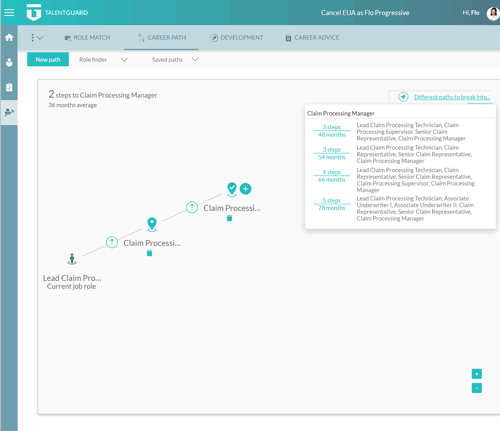
The structure and design of the modules are outdated and need better organization of information while simplifying the usability. The first goal of this project was to focus on one module, Career Pathing, and use it as a standard for the remaining modules.

Users & Audience

The challenge in determining a user group for this project is this software benefits on both the executive level as well as the employee level. Seeing as how usability was such a large focus on this project, a majority of user testing and feedback came from HR employees and department employees.

Solution

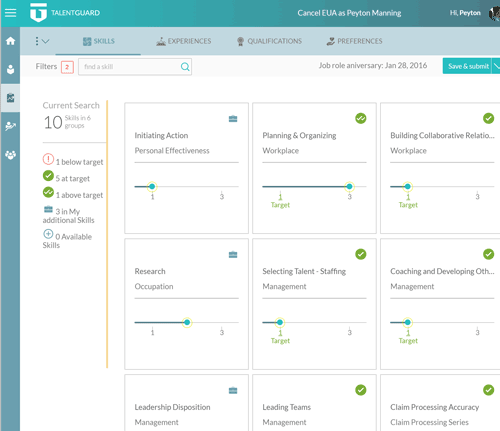
o  Added a side bar main navigation and made it collapsible to provide more screen space for the large amounts of information that needed to be displayed at times.

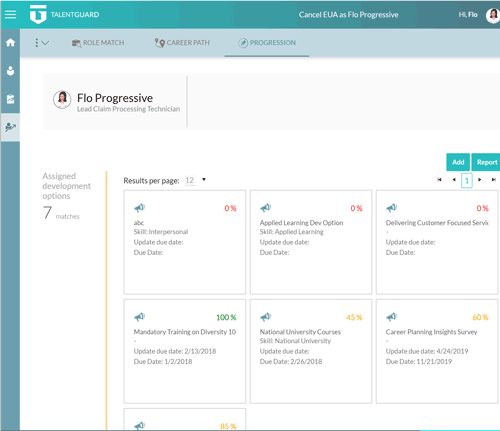
o  Converted all the lists and charts for employee and manager information into expandable tiles with summary information for a quick glance into that individual. Tiles could be expanded for more information and click through to their work profile.

o  Designed a whole new minimalistic icon set to better align with the new modern look of the layout.

o  Created and designed a welcome walk through wizard for new users based on weeks of real human user feedback and A/B testing.

o  Enabled full branding customization for clients including adding logos, color, and background imagery.

The Work

The Final Product